

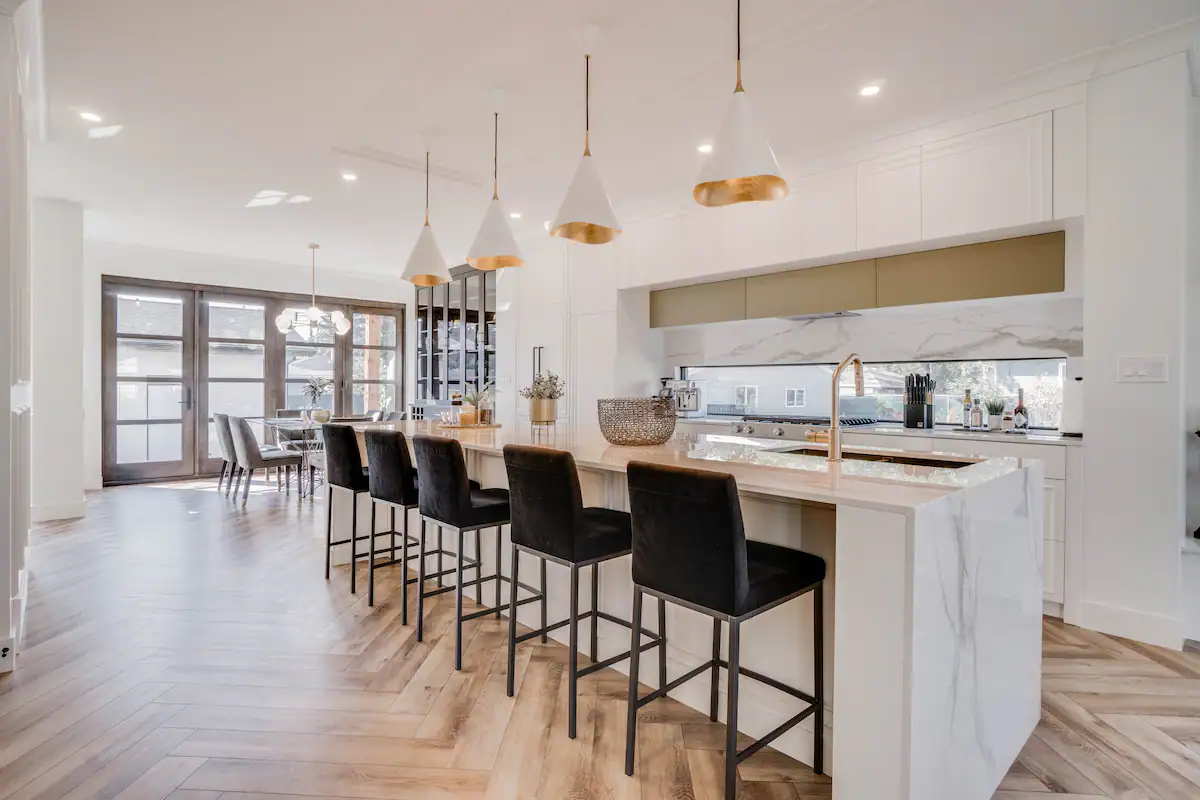
There are more than a hundred residential builders operating in the Edmonton region. Somewhere between 20 and 30 of them do custom infill in the mature core with any real frequency. And of those, maybe 8 to 12 build the kind of house a $1.2M-plus budget deserves.
This post is a checklist of what actually separates the shortlist from a hollow bid. Written by a builder that has been on the other side of these first meetings, and has watched owners fall for the wrong signals more than once.
Ask to walk a house they finished 3 to 5 years ago
Not the model home. Not the just-completed one that has never been lived in. A house the same builder finished 3 to 5 years ago, that a real family has been living in.
A three-year-old house tells you what happens when a builder's work meets weather cycles, foundation settlement, appliance installation, hardwood movement, and the kind of hairline cracks that only show up in the second Edmonton winter. It also tells you how the builder handles the warranty period after the money is done moving.
If a builder cannot arrange this, or does not have a house that old to show, that is a signal by itself. Every builder we know who does good custom work has clients who will let a serious prospect walk through, because they know the referral is what fills the pipeline.
Ask for the last five clients' phone numbers, not the testimonials
References cherry-picked into a booklet are useful for reading style, not much else. The five most recent clients are what matters. Any builder doing mature-core infill at a $1M-plus price point talks to their recent clients often. The number should be easy to hand over.
What to ask those five people:
- What did the builder tell you would go wrong, that ended up going wrong.
- What did the builder promise on the schedule, and what happened.
- Was there a change order dispute, and how was it handled.
- Would you use them again on a house of the same size, honestly.
- What did you underestimate about the process going in.
The last question is the tell. Owners who have finished a real custom build have specific answers. Owners who felt handled through a process nobody explained to them have vague answers.
Look for the same team on your job that quoted your job
This is the single largest split between builders whose $1.2M number holds together and builders whose number turns into $1.6M by the end.
A shop where the estimator, the site super, and the finishing lead are three different people with three different phone numbers is a shop where information falls through the gap between them. A shop where the person who quoted your kitchen island is on site the day it is installed is a shop where things do not fall through.
We stay small on purpose. The person who quoted your kitchen island should be the same person you can text on the day it goes in. That is how numbers get held. Every extra layer between the field and the file is a place where information falls, and every re-decision after that is a change order the homeowner did not plan to see.
Read the exclusions, not the bid total
Every custom infill quote in this market runs 15 to 40 pages. The first two pages are the total number and the payment schedule. The exclusions section is where the price difference lives.
Common exclusions that a low bid hides in the fine print:
- Appliance allowances set at builder-grade numbers ($8,000 to $12,000 total) when your finish level requires premium ($25,000 to $50,000 for a real appliance package).
- Cabinet allowance set at the low end of the local range, with the actual selections trued up as change orders.
- Site services (water, gas, power, sewer connection) excluded, especially on lots that need a new service run.
- Landscape excluded entirely, or capped at a nominal amount that will not cover a driveway plus grading plus a rear deck.
- Basement finish or basement suite excluded as an "optional add-on" that was in your original conversation as a scope requirement.
- Permits, city fees, and warranty enrollment excluded, so $15,000 to $25,000 of soft costs land on your side of the ledger post-signing.
Two identical-looking quotes with a $200,000 spread almost always resolve into the same total once the exclusions are lined up. The exercise takes an evening. The alternative is finding out on the change order.
Verify warranty enrollment and WCB up-front
Every new home in Alberta requires enrollment in a licensed New Home Warranty program. The Alberta government website publishes the list of licensed providers. Alberta New Home Warranty is the largest; there are others.
Ask the builder for the warranty provider name, their builder license number, and the year their license was last renewed. Then look them up on the warranty provider's own site. This takes 5 minutes. Any legitimate builder passes it. Any builder who cannot pass it does not have the coverage they need to be legally selling you a house.
Same test for WCB Alberta coverage: ask for the account number, look it up on the WCB Alberta clearance letter site. If the coverage is not current, you have personal exposure on every site injury during your build. Our full WCB and licensed contractor guide walks through exactly what to check.
Watch the response time in the first two weeks
A builder that will still be responsive after you have signed the contract and paid the deposit is a builder that is responsive before you sign anything. The two-week test: send a real question by email on a Tuesday, and see whether it is answered by Thursday.
The point is not to test people's patience. The point is that a builder with an operations shop that keeps up in the pre-contract phase, with no financial obligation to yet, is a builder whose operations shop will keep up during construction, when you have paid five draws and are 30 percent through the build.
Prefer a builder who says no to things
A builder who says every idea is possible on your budget is a builder who has not run the numbers, or has and is planning to bring them back at change-order time. A builder who tells you your budget will not cover a 12 foot main-floor ceiling AND a rooftop terrace AND a wine room, and asks which two matter most, is a builder who is negotiating up front and not later.
The polite refusal early in the process is worth more than any promise. It is also the reason a "yes to everything" quote often ends up costing the homeowner more, once the change orders start.
The finalist test
Once you have two or three finalists, ask each one for the same specific thing: a line-item budget of their most recent completed project at your intended size and finish level. Not a quote for your house, a real one already built. Fully priced, exclusions listed, actual variances between the original quote and the closeout number shown.
Every honest custom builder has this document sitting on file. It takes ten minutes to pull it together. It shows you two things at once. What kind of house their $1.4M number actually builds, and how tight their estimate was against the closeout reality.
If a builder is unwilling to share this, you are being asked to sign a contract on a black box. The house that comes out of a black box is a series of surprises. Some of them are good. Most of them are not.
For the cost side of the same conversation, our Edmonton infill cost pillar breaks down what actually drives the per-square-foot number so you can compare quotes with the right yardstick.